
Bradford core city analysis and affordable homes
Population
Bradford is a significant conurbation with a total population of 563,605 residents, ranking 5th in comparison to other English core cities when looking at the local authority as a whole. However, it has the lowest proportion of working-age residents (16–64) at 62.2%. In this regard, it ranks 9th when compared to the core cities.
It also has the lowest share of young people (16–24) at 11.6%, ranking 9th. Although Bradford is often described as having one of the youngest populations in the UK, this mainly reflects its high share of children aged 0 to 15 years (22.3%). The data shows that many 15–19-year-olds then leave the district, while core cities typically attract people at this age, most likely to study locally.4 Reflecting these trends, ONS projections indicate that the proportion of 16–24-year-olds will decline to 11.5% by 2035.
Bradford’s healthy life expectancy for males is 57.5 years, placing it 7th among the core cities. For females, the figure is 58.1 years, ranking 5th.
Bradford has an average deprivation score of 36.7, placing it 6th among the core cities, indicating relatively high levels of deprivation. Its lowest-performing domain is Education, Skills and Training, highlighting particular challenges in this area compared with other core cities.
Pay & Income
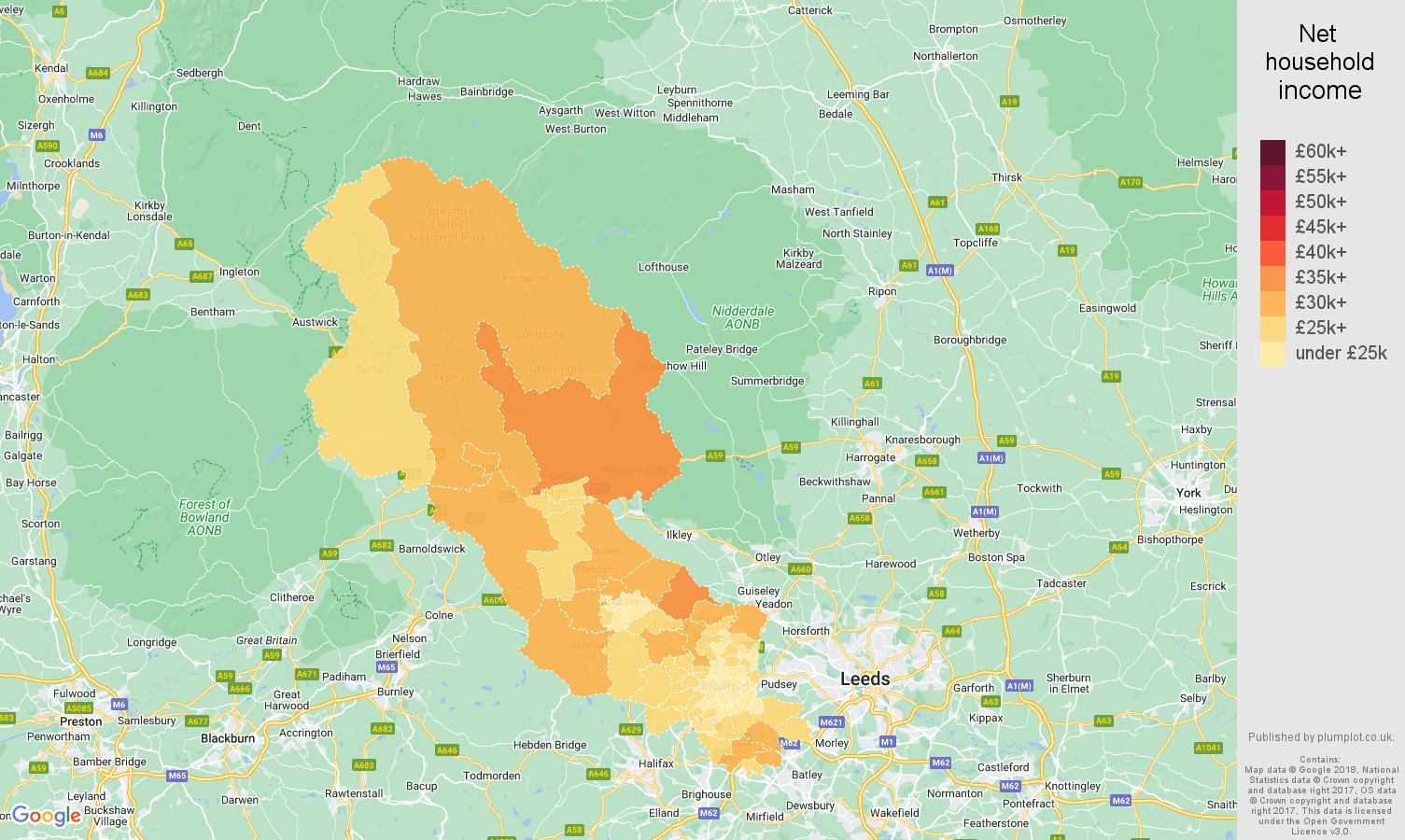
At £17,784 per person, Bradford ranks 8th overall compared to the core cities in terms of gross disposable household income, suggesting lower average household financial resilience and spending power compared to most other core cities. Bradford’s gross median weekly pay is £560, also ranking 8th overall.
In addition, 44.2% of children in Bradford live in households below the relative poverty threshold (before housing costs), the highest rate in comparison with the core cities.
Education & Skills
Only 41.2% of Bradford’s working-age population hold higher-level qualifications (e.g. degree or equivalent), placing it last (9th) when compared with the core cities. 9.1% of residents aged 16–64 have no formal qualifications, ranking 6th overall.
Similarly, 68.2% of young people in Bradford achieve a pass in English and Maths by age 19, ranking 8thout of all the core cities.
Productivity
Bradford supports 204,000 jobs, ranking 8th compared to the core cities. With a ratio of 0.65 jobs per working-age resident, Bradford ranks last (9th). This indicates a shortage of local employment opportunities relative to the size of its working-age population.
Note: The working-age population will grow to meet the lowest target of 65%. Based on the ONS forecast of 63% by 2035, achieving the lowest core cities’ job density value of 0.83 would require an additional 76,000 jobs.
At 69.1%, Bradford’s employment rate ranks 5th. This suggests that, despite fewer jobs locally, many residents are engaged in employment, most likely outside of the district. Female employment, however, remains lower at 62.9%, ranking 7th, suggesting barriers to participation for women.
Bradford’s economy is characterised by relatively strong employment participation which is positive. Around 27.4% of working-age residents are not in employment and not actively seeking work, placing Bradford 4th compared to the core cities. Bradford’s unemployment rate stands at 4.9%, ranking 4th when compared with the core cities. Around 7.2% of residents aged 16–64 are claiming unemployment-related benefits20 (claimant rate), ranking 8th and the second highest after Birmingham.
The proportion of young people aged 16–17 not in education, employment or training (NEET) stands at 4.1%, ranking among the lowest of core cities, indicating strong post-16 participation.
Affordable housing?
See:Bradford Core Benchmarking Analysis.
In many areas of the Bradford district, house prices are extremely low, and that yields the following information:
Local authority |
Median house price / salary ratio in 2024 |
|---|---|
Bradford |
5.2 |
North Yorkshire |
7.3 |
England and Wales |
7.54 |
Superficially this looks good for the district’s younger residential population.
Many homes are being delivered on the district’s green belt, some are social housing, others are classed as affordable or shared ownership. House pricing for shared/affordable ownership are high, often starting from £300,000 up to £350,000. If you choose to buy the remaining share of a property, the assocaited costs are significant. Let’s look at a couple living in the district who are looking to buy their first home.
The Gross median weekly pay for Bradford is £560.00 per week, so a couples combined gross earnings of £58,240 before tax and NI, with combined monthly outgoings of £800.00 per month would repay a mortgage of circa £1,600.00 per month, assuming that they pay a deposit in the sum of at least £30,000.00. It’s not hard to do the maths and this illustrates the issue faced by housebuyers in today’s market.
A typical representative example.
This is an illustration of a typical mortgage and its total cost. A mortgage of £195,000 payable over 25 years, initially on a fixed rate for 2 years at 4.14% and then on our variable rate of 7.24% for the remaining 23 years, would require 24 monthly payments of £1,044.42 followed by 276 monthly payments of £1,383.5. The total amount payable would be £406,911.35 made up of the loan amount, plus interest of £211,911.35. The overall cost for comparison is 6.8% APRC representative.